Friday, August 6, 2010

Beneath The Fog

There were clouds in the sky as we motored south towards Nanortalik but no trace of the fog that had concealed the area a week prior when we made our way north. Giving us a very different picture of the landscape. The only similarity was the head wind that seemed to have conveniently turned with our direction. While we were motoring through a narrow passage, a humpback whale came right up beside us. It was feeding in the shallow water, only showing a small part of its body as it surfaced to breath. We have seen very few marine mammals in Greenland and this was an exciting encounter.

Humpback Whale Swimming Beside Snow Dragon

The tight channels at Sardloq where we had watched the seals being skinned were even more impressive now that we could clearly see the granite rock beside us. It was tempting to stop and spend more time at the community. Especially when a few of the residents came out and waved but we knew the fog's absence was only temporary.

As we neared Sydproven we could see that bergs still dominated the entrance to Zakarias Havn and had possibly grown in number. There was also a large iceberg, grounded in front of the village. At Akuliaruseq which consists of a couple of houses and a church, we looked at an inviting bay that we had bypassed on the way up due to a resident iceberg. The iceberg had relocated but the bay was open to swell and looked less appealing in the fading light.

With wisps of fog moving in we decided to push on to Unatoq, where we knew we could find a good anchorage. With the above average visibility, we chose to anchor at Igpik (60' 30N 45' 19W), behind the spit on the north side of the island. Which we had previously avoided because of thick fog and large icebergs. The sun was setting as we dropped the anchor, bringing out the color in the pebbles on the spit and the blue of the iceberg towering behind. Once we were firmly anchored the wind increased dislodging a local powerboat that had been at anchor up wind of us, luckily the crew was on board and realized what was happening. When they were only a boat length away, they quickly started their engine and motored away from us waving cheerfully.

Sunset At Igpik

The whiteout that followed the next morning inspired hibernation. By noon the shore was beginning to make an occasional ghostly appearance. Frances had wanted to paint one of the icebergs sitting near us but that to was cloaked in white. Eventually the fog cleared and after Frances finished her painting we went to shore to take in the view from a small hill. By the time we got to the top, the fog was beginning to drift back in. Making the setting seem surreal with Snow Dragon anchored off the white sand beach, bergs in the background and mist floating gradually closer.

For more photos please click on  Unatoq2 Album.

Thursday, August 5, 2010

Experimental Agriculture


Snow Dragon At Anchor, Upernaviarsuk Research Station

Tucked in between gentle granite hills is the Upernaviarsuk Research Station, an experimental farm trying to manipulate agriculture to suit the arctic. Even below the arctic circle, southwest Greenland is above the northern tree-line and not a land of fertility. Looking at the hay fields and perfect rows of cabbage. Maybe Eric the Red was not so far off when he named Greenland, a name he had selected to entice settlers.

Our interest ranged from curiosity to practicality. We wanted to find out what they were able to grow successfully and thought it might be the ideal source for purchasing good quality vegetables. Aside from a speedboat full of teenagers that arrived after us, the farm was quiet. A sign near the dock showed where the Norse, Eskimo and Colonial ruins were located but gave no additional information. There were two Danish men working in the greenhouse but they did not acknowledge us. We figured that since it was Sunday, they were not interested in dealing with visitors.

We wanted to continue looking around but all the fields were fenced. Not being sure of the etiquette we decided to walk out of the main farming area to pick blueberries. The land had been grazed and blueberries seemed to have been a popular item on the menu. We were about to give up after only finding the occasional single blueberry when we discovered a small steep area that had been missed. By the time we had finished, there were enough for another batch of jam.

On the walk back we could see from a distance that our dinghy had been relocated to make room for a skiff. Once at the quay we realized it had been moved to an inaccessible location. It was tied with no slack to the outside aft cleat of the skiff, making it impossible to reach from the ladder and the swell that was rolling in did not help bring it any closer. It took all of Frances' courage to be able to hook the skiff with her foot and jump down onto the slippery bow of the speedboat. She was then able to reach the dinghy, pick up Krystina and return to the boat. Snow Dragon was sitting bow towards the swell, which made the motion comfortable, but we still selected several alternative anchorages in case the wind continued to increase. Neither of us wanted to move and were content to put up with the motion.

Only the group of teenagers that were there presumably to learn about farming, were evident when we returned in the morning. Eventually we found a woman by the greenhouse who was able to explain that the gardener was in town and we would have to wait until he returned. We debated staying but felt that they were not that keen on selling their produce. When a small group of tourists arrived, we noticed they were also being left to wander on their own without any interaction from the staff, we knew that moving on was the right decision.

The bright, sun-lit farm that we arrived to reminded us of Norway. While the clouds that filled in as we left took some of the cheeriness, it still failed to bring our attention back to the fact that we were in Greenland. Maybe its because we associate the area with the harsher realities of the arctic climate, not the soft nurturing aspects of nature. Or that we left without gaining a better understanding of the project's viability. Perhaps agriculture will have a bright future in Greenland if global warming is here to stay. For now the sheep need to be kept indoors during the winter and greenhouses still play a vital part in Greenlandic gardening.

For more photos please click on Upernaviarsuk Research Station Album.

Photos Added

Photos have been added to 515 Meter View.

Tuesday, August 3, 2010

A Second Look At Qaqortoq


Canvass And Wood Frame Kayaks

By our second morning at Sildefiorde, the rain and fog returned leaving no trace of the previous summer day. We contemplated staying another night to avoid moving in the pouring rain but decided the most productive way to spend a wet day was for us to go back to Qaqortoq. Where we were planning to provision for our upcoming passage to the Azores. We were completely soaked by the time we arrived and were not looking forward to anchoring outside the harbor. Which would have entailed a long dinghy ride in the rain. Once again we had crossed paths with Resolution and they suggested we might find space at the wharf ahead of the large ships. The spot was occupied by two Danish survey vessels that were rafted alongside. After not being able to raise them on the radio we decided to go back our and look at our anchoring options. By that time the wind had come up and the anchorage looked even less attractive. We went back into the harbor one more time to try to get the attention of one of the survey ships to ask if we could raft up to them. It turned out not to be a problem and we waited patiently for a local power boat who was tied up to them to load its passengers and leave.

The crew of the Danish vessel kindly helped us secure our lines. They had remembered seeing us at Nanortalik and we talked with them about our plans before going inside to warm up. After taking the time to change the engine oil, the rain let up to a more reasonable drizzle and we ventured into town to get a start on some of our errands. Krystina spent some time with Qaqortoq Hotel's temperamental WIFI, updating blog photos. While Frances went to the grocery store to make a start on the provisioning.

Our plan had been to only spend one night but we were having an enjoyable time getting to know the survey vessels and still had a list of tasks that would make another night productive. A small cruise ship came in and moored behind us. Some of the Finish passengers stopped to photograph Snow Dragon and we exchanged greetings. The tourist office had told us that we could join the cruise ship group for a tour of the Great Greenlandic Fur House, the local tannery, but we decided that joining a tour of 40 people was not the appropriate forum to ask our economic and cultural questions regarding the Greenland fur industry.

For our second round of provisioning we decided to use our dinghy instead of trying to pass groceries across the two survey boats. We were mainly in need of bulk items like UHT milk, sugar and flour, which are relatively easy to find in Greenland. The fresh fruit and vegetables were not in good shape and we opted to try some of the frozen mushrooms and berries instead. After stowing our shopping, we stopped at the Thai restaurant in the center of town for coffee. Their menu looked interesting and we made a dinner reservation. However, we quickly canceled it after hearing from one of the other boats that it was the worst Thai food they had ever had. We might have given it a second chance but not at Greenlandic prices.

Before going back to the boat we made one last stop at the hotel, where we met a newly arrived Danish couple. they were sitting in the hotel's cafe and invited us to help them finish their french fries. We asked them what brought them to Greenland and they explained that they would be teaching at the high school in Qaqortoq. Our discussion drifted between education and Denmark's involvement in Greenland. The story of Danish sovereignty over Greenland lacks a fairytale ending and reads similarly to that of other colonial powers, smothering culture and exploiting people and resources. The couple came back with us to meet Snow Dragon and joined us for a tour of one of the survey vessels.

Frank the engineer on Birkholm gave us an in depth tour of the ship's systems and explained that all Danish naval ships are designed with an interchangeable "container" so that vessels can easily be re-outfitted for different missions. One of the surveyors showed us the 3D imagery they get from the data they collect using a highly sophisticated depth sounder. Both the tides and the ship's movements are corrected for and the resulting image is impressive, clearly showing the topography. When they return to Denmark in October, the surveyors will spend the winter correcting their data and looking for any discrepancies. The information is then made available to the Danish navigational chart producer but due to lack of manpower it will take up to ten years for the new information to be used. At their current rate of surveying it will take thirty years before the main portion of the west coast of Greenland is complete.

We saw another sailboat come into the harbor and motioned that they could raft up to us. It was a group of Norwegians who were bringing a boat from the Caribbean to Norway. The skipper had been in Svalbard last summer and had not seen us but it turned out that we knew a lot of the same people. The next morning Frances decided to take a look at the second grocery store in town and came back with a locally grown lettuce. It seemed a fitting end to our time in Qaqortoq as we were heading for an anchorage near the farming area.

For more photos please click on Qaqortoq2 Album.  

Monday, August 2, 2010

515 Meter View

Iceberg Sitting In The Entrance To Sildefiorde

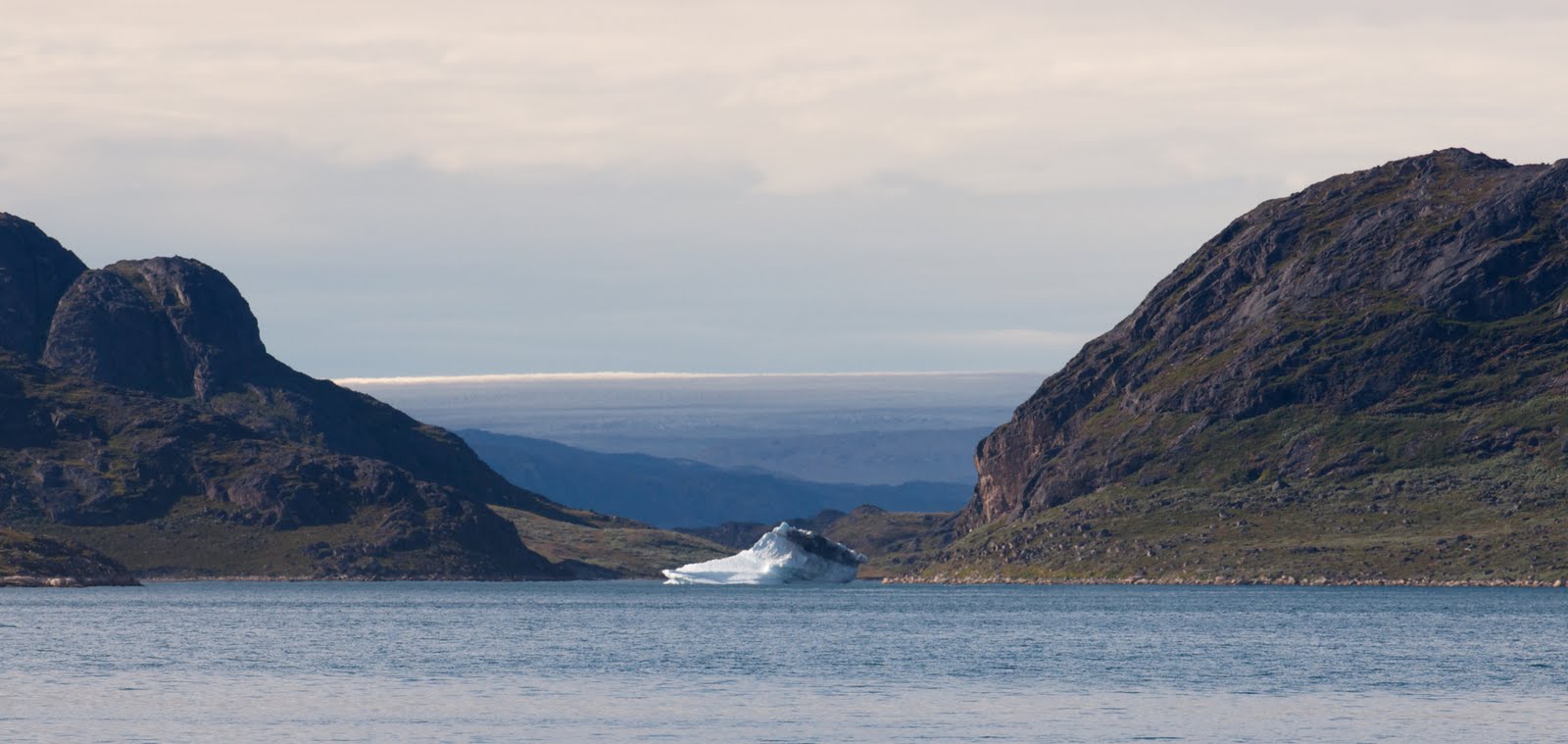
At Sildefiorde (60' 51N 46' 25W), we found a spectacular anchorage surrounded by low steep granite hills with a sliver of icecap peering between. The token iceberg that sat in the middle of the entrance had left us plenty of room to get past. After a narrow granite walled channel that reminded us of a gorge, the bay opened. There were two houses on either side and a chute for loading the farmed reindeer that roam the area. When we passed the yellow house, a man of European appearance came out and waved.

It took a bit of circling to find good depth without being too close to shore. After making sure we were not going to end up on the beach if the wind picked up, we headed to shore to get a better acquainted with our surroundings. We chose a knoll at the head of the bay that gave us a look at the cloud covered icecap and of the bay on the opposite side that we had contemplated going into. Before the end of the walk their was no doubt this would be a two night anchorage.

Snow Dragon At Anchor

We woke up to a beautiful sunny, day our first in over a week of rain and fog. perfect weather for our planned hike up to Iganarssuanguaq, a 515 meter peak, the highest on the island. Two reindeer pranced in front of us as we contemplated the best route, the only evidence we saw of them apart from bleached antlers. The vegetation and 15C temperature made the steep climb with quick elevation gain a little tortuous at times but the view was worth the effort. From the top the icecap dominated 180 degrees of the horizon while lakes and islands filled the rest of the landscape.

Going down took more concentration but was physically less demanding. The vegetation was not as thick but every time we needed a handhold, juniper with its sharp needles seemed always to be evident. Since we still had a lot of distance to cover we resisted the temptation to pick blueberries until we were well down. After carefully walking and sliding our way down from the ridge, the valley proved to be an easy stroll back. We had been planning to stop by the yellow house and say hello. But during our hike we saw the man take down his Danish flag and prepare to be picked up by a boat. He had already left by the time we returned. After six hours of exploring, we were ready to head back to the boat and enjoy a more substantial meal than the sandwiches, chocolate and blueberries during our hike.

For more photos please click on Sildefiorde Album.


Sunday, August 1, 2010

Remains Of The Past

After looking at the options when we left Qaqortoq we opted for Snow Dragon's specialty, inventing an anchorage. We chose Singitsut (60' 44N 46' 12W), a bay that was the site of an Old Norse settlement. The area reminded us of Norway and we wondered if the similarity struck the settlers as well. By the time the anchor was set, the fog had enveloped the remaining patch of blue sky. After dinner we set off for shore and during our walk we found ourselves pondering the unknown fate of the Norse settlers who managed to survive for 450 years before suddenly disappearing. It is a question that has stumped historians and archeologists. One popular theory is that they were defeated by the slow change in climate that brought on harsher winters. Another is that they packed up and went back to Norway or the New World. It will probably remain one of history's greatest secrets but there are still lessons that can be learned from what is known about the Norse settlers. They faced climate change in the form of the little ice age. Instead of taking notice of the longer winters and trying to learn from the Inuit who had the skills to thrive during this time, they maintained their isolation and farming culture, unwilling to adapt.

We motored out of the marginally charted side exit of the bay that took us directly back into the main channel. The wind looked promising so we raised the main and let out the jib. As we sailed along Resolution, the sailboat we had met the day before, motored up beside us. To our surprise on of the crew members asked if the boat used to be docked in San Rafael, California. Turned out he used to walk his dog down the dock every morning where Snow Dragon used to be berthed.

Iceberg Near Narssaq

 The density of icebergs dramatically increased once we turned into Narssaq Sund making us suspect that Srephensens Havn (60' 56N 46' 11W), our planned anchorage was already inhabited. With binoculars we could see the main bay was crowded with bergs but we decided to take a closer look just in case our anchorage, which was an offshoot of the bay had remained ice free. It had a small berg but nothing alarming and we anchored upwind of our icy neighbor.

Snow Dragon At Anchor In Stephensens Havn

After a peaceful night we went to shore to look at the Eskimo ruins which are reputed to be the largest in Greenland with 24 winter houses dating back to 1350. In Greenland though the people refer to themselves as Inuit, they refer to the older remains as Eskimo. All that remained was the evidence of the circular foundations. We walked up to a varde which had a lovely view of the icecap and numerous bergs floating in the sound. On the way down Krystina realized she had dropped 'animal', her fake fur hat. We retraced our way back to the varde, scanning the ground for the well-camouflaged hat. This time we were lucky and were able to find it.

For more photos please click on Stephensens Havn Album.

Photos Added

Photos have been added to A Greenlandic Community, Modernizing Tradition, A Glimpse At A Greenlandic Community, Hot Springs With An Icy View and Week To Greenland.