Friday, June 21, 2013

The Faroe Islands: Leaving Is Not Always Easy


Small Fuel Dock, Torshavn

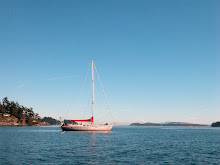
Though it would have been nice to spend to spend another week in the Faroe Islands, we had to settle for 4 days as the weather was ideal for crossing to Iceland. On the way out of Torshavn harbour we attempted to squeeze onto the small fuel dock, between a 90 degree concrete wall and large slopping boulders. When we were almost alongside, we realized the dock was indeed too short and moved Snow Dragon away before the dinghy and outboard motor hanging in the davits came in contact with the concrete wall.

We had enough diesel to get to Iceland but it was much more cost-effective to fill in the Faroe Islands. There was a fuel depot nearby so we thought it was worth pulling up to the commercial dock and enquiring whether they could send a truck. Sure enough they understood the difficulty getting into the official fuel dock and had no problem sending a truck. We were a little confused when they asked us what kind of diesel we wanted, a choice that is not normally given. In the end we settled for the same kind the fishing boats were using, figuring that was what Snow Dragon was used to.

Fueling, Torshavn

Once Snow Dragon was topped up with 500 liters of diesel we continued around the south of Streymoy and through Vestmannasund. On the west side of Streymoy, we did another weather check to see if we could spend another day in the Faroe Islands without loosing our weather window to Iceland. The forecast showed favorable southerly quadrant wind for two days, a day of variables and then northerly for the rest of the week. We decided to risk the variables turning into headwinds and stopped at Tjornuvik, which came highly recommended by an American photographer who we met in Torshavn and our cruising guide, which listed it as the best anchorage in the Faroe Islands. 

Entering Tjornuvik 

The stop was worth the risk. At anchor we could see glorious sea stacks, explore a hidden waterfall by dinghy and walk around a delightful village. The lower slopes of the huge amphitheater were covered with very lush green grass that was soon going to be cut for hay to feed the sheep in the winter. 

We left the Faroe Islands with both sadness and excitement. Our time in the North Atlantic showed us just how spectacular the sailing based travel could be in the area and we longed to return to Ireland, Scotland and the Faroe Islands. Finally after one more trip to see the waterfall, we pulled anchor and said goodbye to Tjornuvik. Our one consolation was that we knew from previous experience that Iceland and Greenland were well worth the effort.

Krystina Inspecting The Hidden Waterfall, Tjornuvik

For more photos please click on Leaving Faroe Islands Album 

Monday, June 17, 2013

Faroe Islands: Fog, Blogging And A Day Of Pancakes


Tallship, Tvoroyri

The sunshine we enjoyed in Scotland disappeared when we arrived in the fog covered Faroe Islands after an easy two day passage from St Kilda.  In Tvoroyri, we hibernated at anchor, using the downtime to catch up on creative pursuits. Frances worked on drawing and painting while Krystina finally tackled restarting the blog. We braved the rain and fog and ventured into town for a walk and hot chocolate at a cafĂ© that had originally been a traditional fisherman’s supply store. The fishermen could purchase their supplies on credit and repay it six months later when they returned from sea.

In hope of getting our propane tanks filled and the electric start on our outboard looked at we headed over to Torshavn, the capital of The Faroe islands. The thick fog only lifted long enough to give a few patchy glimpses of land while we motored in uncomfortable, confused seas. At the dock a British sailor helped us with our lines and asked us over for a drink. After a lovely visit we invited him and his partner for breakfast on Snow Dragon.

We returned from our neighbor’s at 2am and after a few short hours of sleep, prepared a large batch of sourdough pancake batter. When our guests didn’t show up as planned, Krystina went over to their boat to double check they were joining us. It turned out they had decided not to, leaving us with a large batch of batter and only two of us to eat it.


We decided the best solution was to eat pancakes for breakfast, lunch and dinner. In the middle of our breakfast of pancakes, bacon and homemade blueberry and quince jam, the customs official dropped by to clear us into the Faroe Islands. He declined our offer of pancakes but was happy to let us answer questions while we chewed.


For lunch our pancakes were topped with onions, mushrooms and a fried egg. By dinner we couldn’t possibly face another pancake and opted for leftovers. Our pancake overdose subsided in time for lunch the following day and the remaining pancakes were eaten with camembert, green onion, bacon and basil. Followed by pancakes with camembert and jam for dessert.    

In the mean time we successfully got our American propane tanks filled. The company even picked them up and delivered them, saving us an expensive taxi ride. Though they are the same fitting as a European commercial bottler, most countries refuse to fill them due to regulations. We also managed to organize a mechanic who showed up at 9.45pm on Friday night in the rain. He was more than happy to work on the outboard but we told him we completely understood if he wanted to come back in the morning when the weather was supposed to be better.  

 Kids In ATraditional Rowing Boat, Torshavn

On Saturday, the fog disappeared and everyone came out to enjoy the sunshine, strolling along the water front and sipping cold drinks outside the cafes. While the rain and fog had made it easy to concentrate on getting the blog up and running, staying motivated during the one sunny day we were likely to see in the Faroe Islands was difficult but Torshavn was Krystina’s last chance for internet access before Iceland. We also had to wait for the mechanic who showed up as promised and fixed our outboard. By the time the mechanic left and Krystina finished uploading photos and her post, the fog had returned. To get more of a feel for the area, we walked into the outskirts of the town and enjoyed being entertained by a playful sheep. 


Video Of Playful Sheep
For more photos please click on Faroe Islands Album

Sunday, June 16, 2013

St Kilda: Home of Birds, Cliffs, Sheep & Hardship


Hirta Cliffs

What is striking about St Kilda is the inhospitable nature of the islands. All four of them are dominated by steep cliffs with minimal or no level ground. An environment much more suited for puffins, fulmars and gannets that nest there than humans. Only Hirta, with the highest cliffs in the British Isles and its two deep bays with no natural landing was inhabited.


Puffin Taking Off After A Dive

Apart from a small amount of gentle slopping land, it’s a rigorous vertical walk to get anywhere on the island. Even hunting sea birds, the main source of the communities food was a difficult, time consuming and dangerous task that was not always successful. The preferred method was to take a small boat to a cliff base and then climb to where the birds were nesting and capture them by hand. Though the community’s food supply was limited they always shared what they had with each other and showed extraordinary hospitality to shipwreck survivors who were victim to the archipelago’s treacherous coast.


Village Street With Houses & Cleits

The steep grass covered valley around Village Bay is covered with stone cleats that were used for storage, towering above a neat row of abandoned houses. Even the modern military base is dwarfed by the landscape.


Soay Sheep

The other evidence of the community’s existence are the Soay Sheep, a 4,000 year old breed thought to have been introduced by the Vikings. When the sheep on Hirta were rounded up for auction to pay for the communities evacuation, the sheep on Soay were left to fend for themselves on the island as they were too difficult to reach. Thanks to their isolation, they have remained genetically pure. Today they live wild on Hirta, dropping clumps of fleece around the island.

We left St Kilda with a better understanding of its hardships and charm. The weather was ideal during our visit and were able to spend the night at anchor in Village Bay. By morning the southeasterly swell began to make the anchorage uncomfortable. After another trip to shore we pulled anchor and took Snow Dragon around to Glen Bay on the north side of Hirta to find enough protection to hoist the motor off the dinghy before setting off for the Faroe Islands. Our only souvenirs of St Kilda are our photographs as the archeologist who greeted us on shore reminded us not to remove anything from St Kilda, including Soay lambs.


Soay Lambs

For more photos please click on St Kilda Album

Saturday, June 15, 2013

Surprise Encounter On The Way To St Kilda


We arrived in the Sound of Harris ahead of schedule and dropped anchor for several hours to get some sleep while we waited for daylight and favorable current to continue through the shallow sound. Though the wind picked up during the night we woke to a mirror calm and had to motor through Stanton Channel. Once we exited the sound, Frances thought she spotted a pod of whales and we changed course to have a closer look at the black fins gracefully skimming the surface.

Basking Shark

The whales continued elegantly curving through the water with a confusing number of fins making it difficult to count. However, the more we looked at the shape of their dorsal fins and lack of blows, we began to realize that they were actually two large sharks with prevalent pectoral fins. We turned the engine off and let Snow Dragon drift and made doubly sure we didn’t accidentally fall over the side while we photographed and watched their magnificent movement. Our suspicions were confirmed when one came along side the bow and we could see its gills flexing. Then the other came up behind Snow Dragon, using its tail to steer a sinuous course and mouth wide open to collect plankton.  

Video Of Basking Shark Following Snow Dragon

Luckily we didn’t confirm they were harmless Basking Sharks until after the fact otherwise we would have put on our diving gear and hopped in. Which might not have been the best idea with the world’s second largest shark even if they only eat plankton and small fish they still massive animals averaging 20-33ft in length.


Basking Shark Following Snow Dragon

Still jazzed by our shark encounter we continued motoring to St Kilda. Normally the idea of motoring 45 miles when there are other interesting places to stop nearby would make us reconsider our plans. But in this instance we knew that conditions requiring us to motor meant there was a good chance St Kilda would be a tenable stop. 

Approaching Hirta and Soay Islands, St Kilda

On arrival we called the St Kilda Warden on the VHF and requested permission to anchor and come ashore. He stated that permission was no longer necessary but did ask that we anchor clear of the landing stage that was used by a military landing craft to supply the base. Once Snow Dragon was securely anchored in the clear water over white sand, we made our way to shore not knowing how long we would be able to stay before the wind picked up and forced us to move on. 

Friday, June 14, 2013

St Kilda Becomes An Idea


St Kilda first came to our attention when Krystina saw the book The Life and Death of St Kilda by Tom Steel in the Iona Heritage Centre’s gift shop. Until then St Kilda had meant nothing more to us than a lump of rocks on the chart. From the brief summary on the back of the book those rocks were transformed to remote islands where a special community lived for over 2,000 years until they made the difficult decision to evacuated the island in 1930. Today St Kilda is the UK’s only UNESCO Dual World Heritage Site and remains accessible only by boat in calm conditions. Though the book peeked Krystina’s interest, St Kilda wasn’t on Snow Dragon’s itinerary and she put the book back on the shelf and continued to explore Iona.

Staffa

Back on board the story of the community continued to intrigue her. After a magical stop on Staffa, an uninhabited island also only accessible by boat, she decided to mention the idea of going to St Kilda to Frances. The archipelago required an 80-mile detour, a real commitment of time. It would only be realistic if the weather was favorable to safely stop at St Kilda’s minimally protected anchorage and then continue directly to the Faroe Islands. We agreed to shorten our time in Skye and skip stopping anywhere else in the Outer Hebrides if the conditions where right to attempt a visit to St Kilda but it seemed unlikely the Scottish weather would cooperate.

Staffa

In Skye we got a second chance to purchase a copy of The Life and Death of St Kilda. Reading the book only intensified our fascination with the history of the area. The people who lived on the island were united in their daily struggle to survive in a desolate place where food was scarce and help could only be found amongst other members of the community. With no transport, no supplies and no medical treatment, their only link to the outside world were occasional shipwreck survivors, Victorian tourists and the factor’s annual visit. By 1930 the population that once numbered up to 200 had been reduced to 36 by disease and emigration. With no chance of outside aid to fund a doctor or a ferry to the mainland, the community finally gave into government pressure and agreed to evacuate the island. Sadly their way of life and community was lost once they boarded the ship for the mainland where they were resettled away from each other and forced to adjust to a world were money was needed to survive.

Krystina Taking In The Scenery In Skye Photo By: Georina Ferry

The weather report showed southeasterly wind, the right conditions for sailing to the Faroe Islands but completely wrong for stopping at St Kilda. However, the wind was supposed to be remain light for 36 hours before increasing and we decided to take the chance and risk only being able to sail past the archipelago. 


Sunday, October 31, 2010

Cleaning And Repair


There was no rest for us once we got Snow Dragon Settled into Vilamoura on Wednesday. The mechanic we had organized for the generator was ready to start work immediately and was on board to evaluate the job shortly after our dock lines were tied. Being without a generator since Terceira has been more of an inconvenience than a serious problem. In Terceira we were able to plug into shore power, which kept our batteries charged until we were ready to leave. During the crossing the main source of power drain was Angela our autopilot who needed to work over time in the rough conditions. To conserve power we used the sleep mode on the chart plotter, only turning on when we needed to evaluate our course or check for AIS targets. We also decided not to run our refrigerator-freezer and put bottles of frozen water in the refrigerator to keep its contents cold.

 Snow Dragon’s solar panels were only of minimal use during the overcast passage. When the batteries started to get low, we ran our engine in neutral with the RPMs slightly elevated to get the optimal charging rate from the alternator. Before we left Terceira Frances switched the engine cooling system hoses from the heating system to the hot water heater so that we could heat water without the generator. To get rid of the carbon caused by running the engine at low RPM, we took advantage of the calm water near the marina and ran the engine up to 3000 RPM to burn off the carbon before heading in.

 Disassembled Generator Head And Exhaust Elbow

On Thursday the mechanic returned to disassemble the generator for an overhaul, while we removed the staysail and mainsail to be sent to the local sail loft for repairs. After ordering the parts that the mechanic requested from the U.S., we turned our attention to cleaning the salt off of Snow Dragon other maintenance tasks. With the generator repair going smoothly without needing any prodding, we decided to make a quick trip to England on Monday to visit friends and family. It will also give us the opportunity to pick up boat supplies, which are difficult to find in the Algarve.  

On Friday we explained to the marina that we were leaving Snow Dragon for a brief period and requested that they assign us a more protected slip. Since the one we were in was directly in line with the opening in the breakwater. The wind was starting to pick up and the marina kindly sent two guys to help us change slips. We explained that we did not have bow thrusters and needed to make sure that Snow Dragon did not swing her bowsprit into the electrical box as we left the dock. To which they replied in true powerboat fashion, “why don’t you use your second engine?”. One of the things that we have never been able to get used to in Portugal is that the fingers on the docks are less than half the length of the boat and only reach the midship’s cleat. After safely relocating, Krystina chatted with the guys about our reasoning for moving and explained that Snow Dragon is 25 tons; more suited for pushing ice than sitting in a marina and with surge could easily break the finger. The new slip was of the same configuration but in a much more protected part of the marina and made us more comfortable about leaving her unattended. The new location also improved our view with a bit of greenery instead of the bars, restaurants and hotels that dominate most of the marina. 

Saturday, October 30, 2010

Rough Seas


It was brutal to set of on an 900 mile passage after sitting at the dock for 3 weeks. We had intended to only make a brief stop in Terceira before moving on to Sao Miguel and Santa Maria, the eastern most islands in the Azores. This would have shaved off 100 miles from the passage to mainland Portugal but bad weather, generator issues and good friends kept us in Terceira longer than expected. With the increasing frequency of gales, we decided that we had pushed the season in the Azores long enough and waited somewhat impatiently for a good crossing window. The ideal conditions never came and looking at GRIB files daily became a depressing routine. It was if “all roads” led to the Azores, with headwinds in every direction. Not even changing our destination would have helped the situation. Finally a small low came through the Azores, bringing a few days of favorable northerly wind before easterly headwinds set in again.

Leaving Praia da Victoria

The swell was intimidating from the moment Snow Dragon left Praia da Vitoria’s breakwater and we could feel our stomachs struggling to hold on to our lunch. We hoped that once we got into deeper water the sea would calm down but the discomfort only increased the further we got from shore. Even simple tasks like trimming sails and standing watch became a struggle as we spent the first three days of our eight day passage suffering from the crippling effects of severe seasickness. Which left us unable to even keep a sip of water down let alone Dramamine. Green water was pouring over the pilothouse at regular intervals as the wind climbed above the forecasted 30 knots. Sailing on a close reach, Snow Dragon was being dropped off of 4 meter waves and landing with a forceful slam before being picked up by the next wave. We fell away to a broad reach to minimize the slamming and brought in more sail as the wind climbed. We were over canvassed with our triple reefed main and staysail when the wind increased to 40 knots and began gusting above 50. After furling in the staysail to slow us down we were still surfing along at 9 knots with only the reefed mainsail. 

The bad weather continued into day four and we were really beginning to wonder how we were going to make it through the rest of the passage. Fortunately we got a bit of reprieve when conditions settled enough to enable our stomachs to accept small portions of food and water. By the next day, the big seas returned and once again eating regular meals was suddenly not part of the routine. Luckily most passages are not like this one and memory has a way of softening the discomfort, otherwise we would never do another ocean crossing.

Our only company was the moon that lit the night sky, the waves that constantly beat against the hull and distant ships, which we rarely caught sight of. The birds and marine life seemed to have found a better place to be in the bad weather and were nowhere to be seen after we left Azorean waters. A hundred miles off the Portuguese coast we discovered an additional passenger, a delicate red dragonfly. We had no idea where it came from but were happy to sit on deck and admire the beautiful insect as it flew around Snow Dragon’s rig.

Cliffs, Algarve

 Once we neared the traffic separation zone off Cape St. Vincent, ship traffic increased radically and it felt as if we were crossing a busy highway. The ships we came closest to were very polite and changed course to take our stern without us even calling them on the radio to make passing arrangements. The familiar cliffs of the Algarve did not becoming visible until morning. While it was still dark, we passed Cape St. Vincent, where we had anchored in 2008 after completing a much smoother crossing. This time conditions did not permit a respite and we continued on to Marina de Vilamoura where we had arranged for a mechanic to work on our generator.

Coming into Vilamoura was a bit of a shock. It is the largest tourist development in Europe and not an ounce of local culture in sight. When Krystina asked the marina office for directions to the supermarket the woman told her it was next the McDonalds. The “golden arches” being something that had been absent from our lives for the past six months. At least by the time we arrived at the marina, we had managed to get enough sleep and calories into our system to get Snow Dragon safely to the dock.

Entrance To Marina De Vilamoura