Monday, September 30, 2013

Labrador: William’s Harbour And Our Need For A Man


Before we left Paul’s house in Norman Bay, we asked him if he had any suggestions of where we should stop next and he surprised us by saying William’s Harbour. We had read about William’s Harbour in our cruising guide an although it said the harbour offered good shelter it discouraged people from stopping there since a fire destroyed the docks in 2007 and insisted the bay was too deep to anchor. We knew Paul wouldn’t lead us astray and on closer examination of the charting we realized the average depth in the bay was 30 meters, a perfectly anchorable depth if there wasn’t a suitable dock.

In the morning, we pulled anchor in the pouring rain and motored to William’s Harbour. Between the rain, low cloud and fog there wasn’t much to see along the way. As we approached the entrance to the harbour, we could see the new wharf was full of fish boats and decided to check out the anchoring depths instead. There was plenty of room to anchor in 30-35 meters if needed but after a bit of poking around we anchored in 25 meters near one of the islands protecting the harbour.     


A friendly couple in a local boat came out to greet us and invited us to tie up at the wharf. We were happy with our anchor spot but it was nice to know that the community was willing to make room for visiting yachts. Before they left to go out fishing they asked if we wanted cod to which Krystina answered, “Yes, please,” knowing that though she doesn't often eat fish, Frances would enjoy it.

We took our dinghy over to one of the smaller docks where another local was preparing to go out fishing. He was surprised to see just 2 women and wondered what we had done with the men. After we told him we left Alaska in 2007, he shook his head and said, “I guess you must know how to sail by now”. For some reason many of the people we met in Labrador could not get their head around the idea of 2 woman being able to handle a boat.

While we were walking in the rain we noticed the couple come back in and turned around in hope of catching up with them to thank them for the fish we knew they were about to deliver. They had kindly delivered 2 fresh cleaned cod to our dinghy and returned home before we got a chance to thank them. Instead of tracking them down in the rain we though we would have a chance in the morning to express our appreciation and headed back to Snow Dragon to deal with the cod.


The fish had already had their head’s removed and Frances set about filleting them. Next thing Krystina knew, Frances was standing by the pilothouse door, shaking and pointing her large knife at the sink saying “there is something alive in the bag, can you check?” Sure enough the headless cod was jumping around in the sink still constrained by the plastic bag it was in. After Krystina got used to the idea of a headless fish trying to jump out of the sink, she picked up the bag and put it out in the cockpit to let it finish its gymnastic routine out of sight. Frances composed herself and resumed work on fish number one. Once the cod in the cockpit settled down, Krystina brought it back inside and said, “maybe we do need a man to deal with headless jumping fish”.

In the morning the northeast wind picked up to 20 knots, pushing Snow Dragon a little too close to shore for comfort. Instead of re-anchoring further from shore in the wind and rain, we decided to take advantage of the good sailing wind and make our way to St. Mary’s Harbour. Next year we will have to return to William’s Harbour to thank the couple for the cod and tell them how much entertainment and culinary enjoyment their gift caused on Snow Dragon.


Saturday, September 28, 2013

Labrador: Norman Bay Population 60


From Cartwright we pushed on to Porcupine Harbour where we spent a peaceful night before making our way through the famed passage known as Squasho Run in the rain and fog. Our guide indicated an intimidating narrow passage between granite walls but we found Squasho to be much wider than some of the minute passages we had already been though in Labrador. On the adrenaline scale Squasho was disappointing but still a glorious passage from an aesthetic point of view with lush forest, colorful rock and bright lichen. It seemed the perfect habitat for bears, caribou or moose but we didn’t see any wildlife in Squasho Run other than a few birds tailing a fishing vessel.


After leaving Squasho Run we wove our way between islands and entered Lady Arm just behind the ferry that was delivering supplies to the community of Norman Bay. With the ferry taking up the dock space we decided to drop anchor, getting Snow Dragon settled just as the ferry departed leaving the dock clear. The waterfront had been swarming with activity as the residents collected the boxes of supplies that were being rapidly offloaded. By the time we dinghyed ashore a few minutes later there was no one to be seen. Old and possibly new washing machines, freezers and other household appliances cluttered the dock and Krystina used one of the rusting freezers as a hand hold when she stepped out of the dinghy. 

We walked along the gravel road that ran through the community, unintentionally ending up in the town dump, not the smartest place to be in an area where black bears are common. On the way back we met Paul, who had just come back from working on his summer cabin up the coast and was on his way to feed his chickens. He invited us to his house for a cup of tea.


Paul has spent 30 years living in Norman Bay and had fished for his livelihood until the cod disappeared. Now he works for the government maintaining ‘the Hydro’ for the community, which is actually 2 diesel generators, but all electricity in Canada seems to be referred to as ‘Hydro’. His wife works on the costal ferry and his 16 year old granddaughter lives with him and attends school in the community. It was fantastic to hear that the school was functioning and that there are a fair number of young people living in the community.

Before we left, Paul gave us a salted cod and asked us if we needed potatoes tea or anything else, insisting that he had plenty of food to spare. Here we were in a small community that is boat access only with no stores offering provisions. It was a special gesture and we thanked Paul for his hospitality, assuring him we didn’t need anything and promised we would stop in and see him next time we’re in Labrador.  

The one thing we forgot to ask Paul was why there were so many election campaign signs posted in Norman Bay, a question that will have to wait until next time.

For more photos please click on Norman Bay Album

Friday, September 27, 2013

Monday, September 23, 2013

Labrador: Cartwright Population 500+


Our otherwise uneventful sail to Cartwright turned interesting when our chartplotter suddenly lost our position. Krystina restarted the plotter but it still couldn’t find our position even though the GPS status showed it was receiving data from the satellites. In the meantime we got out our computer with our backup charts and GPS dongle, which operated flawlessly while we switched the chartplotter off and gave it a rest. When we turned it back on 30 minutes later it automatically picked up our GPS position, all we can figure is that it is a software issue and will be sending the plotter back to Furuno yet again. At least it didn’t happen during a critical point in navigation.

It was dark by the time we arrived in Cartwright so we decided to anchor instead of negotiating the dock. By morning the temperature had dropped to 2.5C and we waited in the warmth of Snow Dragon until the late afternoon for the rain and 30 knots of wind to subside before moving over to the dock. As we were attempting to find a way to tie on to the high quay, we met a local named Blair who suggested we would have more protection if we rafted up to one of the fish boats around the corner. The wind was blowing us off as we attempted to raft to Elizabeth Ann and it took several attempts before we were able to get close enough to grab onto something. The fishing vessel was short of cleats and we tied to whatever looked reasonably attached to Elizabeth Ann.

Snow Dragon Rafted To Elizabeth Ann 
Blair assured us that Elizabeth Ann  would not be leaving port in the morning and the skipper had learned his lesson and now made sure his vessel was well secured to the dock. It turned out that a sailboat had been rafted to Elizabeth Ann during a storm with hurricane force winds. Unfortunately Elizabeth Ann had only be secured to one point on the dock which was not strong enough to hold her during the storm and both vessels found themselves aground across the harbour, the sailboat was destroyed. Though it was an alarming story we could see that Blair was right, Elizabeth Ann was now tied to several large bollards, with very heavy line.


Once settled we asked Blair if there was a welder in town as we needed some minor welding done on our stove. He told us we would be able to find a welder at the fish plant in the morning and then kindly gave us a ride into town. After taking advantage of the Wi-Fi at the pub, checking emails, looking at an extended weather forecast and paying credit card bills online, we returned to Snow Dragon to have a closer look at the damaged stove.

Since we knew a welder would be available we removed the stove to assess the damage. Removing the towel and hard piece of plastic we had used to wedge it in place was easy enough. The side with the damaged gimbal was complete free however, when we went to lift up the side that was still attached , it wouldn’t budge. We ended up levering it up with a piece of wood to free it and could clearly see that one gimbal had worn through. We decided it was best not to try to weld directly onto the stove as repairing the light weight stainless gimbal would not solve the problem from happening again. Instead Frances designed a repair that would bolt on and drew a picture complete with measurements of what she needed welded. She then located bolts and washers that would be welded into the new parts amongst our supplies on board so we would not have to impose on the welder’s supplies.

Fish Plant 

In the morning we walked to the fish plant and asked if they had a welder, it turned out they had several. Lots of people came to look at Frances’ drawing, thinking that she must be an engineer. After much discussion we were taken into a workshop to figure out the best way to go about the project before moving into the processing plan were the electric welder was located. They devised a method of holding the small pieces with a bent welding rod and made us 3 beautiful new gimbals. We only needed 2 but when the first one came out slightly crooked they insisted on finding more bolts and washers and making a third. When we tried to pay they absolutely refused payment and said if we did not take our money, it would blow away. It was incredibly kind of them to do the work especially since the fish plant was not even open.

 Welders Working On Our New Gimbals
Since the welders wouldn’t accept payment we decided the only way we could put money into the community was to buy groceries and have lunch at the pub. The grocery store in Cartwright turned out to be the best we would encounter in Labrador and we were delighted to find fresh fruit and vegetables including bananas, asparagus and mushrooms. Krystina even managed to find frozen strawberries amongst the Cool Whip, which were an excellent addition to our morning breakfast smoothies.

Having lunch in town turned out to be a delicious choice, Frances’ chicken Ceasar salad, Krystina’s chicken wrap and our shared order of onion rings well exceeded our expectations. After lunch, Frances headed back to Snow Dragon to begin making the backing plates for the stove out of a chunk of aluminum we had onboard. When Krystina eventually started walking back to the harbour, she was offered a ride by one of Blair’s friends, a very kind offer since it was about to rain. Elizabeth Ann was being blown off the dock and luckily Frances was grinding in the cockpit so it was easy to get her attention. Frances made the leap onto the dock and it took both of us to pull the boat close enough to safely get onboard without risking falling into the water with the computer.

Between weather, services available and extremely nice people, Cartwright turned out to be one of our longest stop in Labrador. After spending 3 nights, we finally left the dock with our beautifully gimbaled stove to remind us of our friends in Cartwright. On exiting the harbour, we could see snow on the mountains behind the town; winter was nipping at our heels as we continued south.  


Saturday, September 21, 2013

Labrador: Emily Harbour & Cloudberries


It was too far from Mesher’s Harbour to Emily Harbour to sail in a day, so we decided to break the trip by stopping at Mostyn Cove at the head of Jeanette Bay. We had fantastic sailing winds and took the opportunity to roll out the staysail and check the repair in 25 knots of wind. The sail preformed as it should and the patch seemed minimal now that we were no longer staring at it on the pilothouse table. Once we rounded Cape Harrison the wind was on the nose and it was clear we were going to fall a few miles short of reaching Mostyn Cove before dark. 

With night approaching we decided to motor into the wind instead of tacking to minimize our travel time in the dark. After looking at the chart we decided to head for Ship Harbour just off the entrance to Jeanette Bay where the soundings looked reasonable for anchoring in the dark. Miss McKenzie I, a 21m fishing vessel, called us on the VHF and chatted with Krystina about where we were from, the weather and harbours in Labrador. The fisherman was heading north to shrimp but his home port was St. Mary’s Harbour in southern Labrador where he freezes Miss McKenzie in for the winter and checks on her by snowmobile. He encouraged us to stop and spend time in St. Mary’s before leaving Labrador.

 Ship Harbour In The Morning
It was completely dark by the time we reached Ship Harbour but true to the chart we didn’t encounter any obstacles and anchored well out to avoid extensive shoals. After spending a peaceful night at anchor, we continued on under sail to Emily Harbour. Though logic told us we should continue to make tracks south, Emily Harbour, a narrow passage between islands sounded too intriguing to pass by.

 Entering Emily Harbour 

Charting of Labrador is deceiving, the coast looks well charted but then when you look closely at the anchorages you realize they’re often either completely un-surveyed or only have a few cryptic soundings. Emily sided on cryptic with the odd sounding and underwater rock marked, just enough to either give you confidence or make you nervous approaching the tight entrance. Once between the islands the channel widens slightly, allowing just enough room to anchor without running a stern line to shore. The south end is completely blocked by drying rocks, making the north the only entrance and exit to the passage.

 Snow Dragon At Anchor, Emily Harbour 
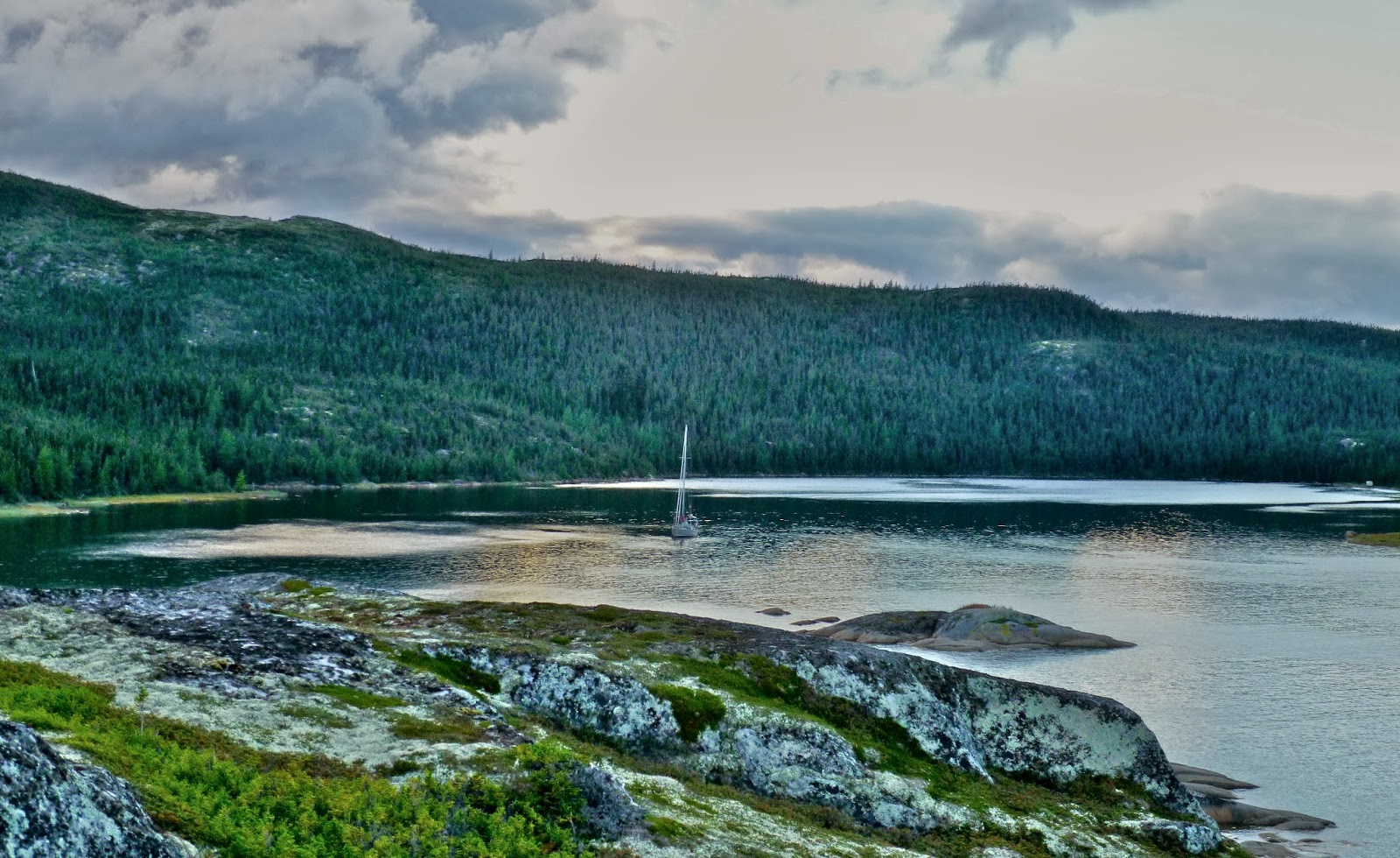
It was nice to have a break from dense forest, the islands where rocky hills with low level vegetation and the remains of a few abandoned cabins. At first the decaying buildings gave a depressing impression of the area but once on shore the complex colors of the landscape and thriving plant life erased the sadness of the gray cabins. The hiking was easy and we had to be disciplined to turn around at sunset to make it back to the dinghy before dark.  

Old Cabin, Emily Harbour 

On the second day wind and rain kept us onboard until the afternoon. This time we decided to visit the other island. The wind was cold but at least it was keeping the mosquitoes away as we leisurely walked along the spine of the island. We were surprised to find that we were surrounded by cloudberries and enthusiastically filled our containers before heading back to Snow Dragon to warm up and then returned to shore to keeping picking. The fading light finally put an end to our cloudberry madness and we returned to Snow Dragon to make the golden berries into jam.

Two nights was not long enough at Emily Harbour but the weather was right to continue moving south. With jars full of jam and freezer full of cloudberries for smoothies we left our snug, magical anchorage and headed for Cartwright.

View From Emily Harbour
.


Prins Christian Sund Photos

Thursday, September 19, 2013

Labrador: Mesher’s Harbour


                                                                                               The wind was too light to test the repair on the way to Mesher’s Harbour, instead we used the calm to run our engine at a higher rpm to burn off any carbon build up. By the time we arrived at entrance to Mesher’s Harbour the wind had picked up just in time to make getting into the bay challenging. Our cruising guide explained that their was a shallow bar and suggested staying 60ft off the starboard side rocks to keep enough water under the keel. The wind strength and direction made it impossible to safely go as close as 60ft to the shore. With the wind pushing us sideways we also needed to cross the bar at a higher speed than we would normally choose to do when crossing a shallow bar to avoid being blown down onto rocks. The one consolation was the guide said the bottom was soft mud so at least we wouldn’t do damage if we bumped bottom. 


With Frances at the bow, Krystina kept Snow Dragon as close to the shore as she could and made it over the bar without seeing anything less than 3.5m on the depth sounder. We didn’t see any sign of the river the guide suggested anchoring by on the north side of the bay and decided to anchor on the south side based on aesthetics. Aside from a small cabin that looked well maintained but not currently in use, the area was wild forest. An unusual sight for us after spending the previous months in areas where trees are few an far between.


 On our way to shore we took the dinghy over to look at the sandbar which was easy to see in the clear water. The bar did appear to be mostly mud but there were a few scattered boulders that would not have been a good idea to hit. Not ready to walk amongst the dense spruce and larch trees we opted to explore one of the rocky islands at the entrance to the bay which only had a few shrubs and trees to negotiate. It was a delightful temperature for an early evening wander and we ended up taking our jackets, hats and gloves off. Without needing gloves it was much easier to pick the blueberries and cloudberries we found amongst the vegetation. The sun was beginning to set but what really drove us off the island were the mosquitoes who were out in force. Little did we know that the bites we received would annoy us for a week.

Krystina Picking Berries With Rifle For Bear Protection