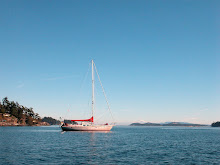
Even in rain and cloaked in gray cloud, Ikerasassuaq (Prins Christian Sund) is a beautiful and enchanting place. With its colorful granite, bold patches of green vegetation and ever changing mountain shape. We have so many fond memories of this special place that returning to Ikerasassuaq (Prins Christian Sund) felt like returning home to an old friend.
We debated where to anchor as we entered the east end of the sound. The two most suitable choices were the Weather Station on the south side or Aqigssiat on the north. Both of us still remember being chased out of the Weather Station anchorage by an iceberg during our first trip to Greenland and opted for Aqigssiat even though the Weather Station was currently free of ice.
As we passed icebergs and two low lying pink and smoky gray granite islands at the entrance of Aqigssiat, we fondly remembered our walk on them 3 years ago and planned a pre-dinner dinghy ride out to see them. By the time we got the anchor set in the deep but tight bay, the rain had returned and we retreated to the pilothouse. When Frances looked at the log she realized we had been anchored at Aqigssiat, 3 years ago on the same date and we opened a bottle of wine to celebrate our return to Ikerasassuaq (Prins Christian Sund).
It continued to rain and we left a water tank open overnight. Collecting 100 gallons of rainwater, putting off our need to fill up on chlorinated municipal water when we reach Nanortalik. It was still raining in the morning and we decided to continue along the sound. When we went to pull the anchor, it wouldn't budge. Eventually we dislodged it by turning Snow Dragon in a tight circle with the engine to put force on the anchor. Clearly the anchor had found something to dig into and came up with a few new scratches on its flukes and full of kelp.
With east winds we sailed the 15 miles to Kangerdluk under jib alone, gybing our way through the sound and dodging the occasional piece of ice. We anchored in a hooked bay off the entrance to a Kangerdluk fjord . With a smooth granite wall on once side and bold green vegetation covered mountain on the other. It took a bit of time to find suitable anchoring depth that wasn't too close to shore and we eventually anchored in 30 meters.
We were too lazy to drop the dinghy in the water to fetch a piece of glacier ice for drinks and resorted to trying to catch a piece from Snow Dragon instead. Frances used a boathook to prod ice towards the bucket that Krystina was dangling in the water. Our second attempted worked and we had enough ice for our 2 tonics with lemon and a splash of gin for Frances.
While Frances was keeping an eye on the vegetarian pot stickers we made for dinner. Krystina created a lettuce free salad to give our plants the night off. She decided on shaved carrot, pineapple and cranberries with orange vinaigrette. When she got the can of pineapple out she asked Frances if Snow Dragon still had a can opener, as she couldn't remember the last time we needed it. With the exception of a can of maple syrup that a friend brought from Canada, we hadn't used a can opener for 2-3 years.
It was tempting just to curl up on the settee with a book and enjoy the view of the artistically placed erratics from the pilothouse window but somehow we managed to motivate ourselves to go for an after dinner walk. The first thing we noticed once we reached the vegetation was the wild blueberries. Frances volunteered to go back to Snow Dragon to fetch a bag but Krystina suggested using the dinghy bailer instead. After washing the salt off the bailer in the stream we began picking our first blueberries of the season. They weren't quite ripe but it didn't matter, we would use them in our breakfast smoothies and salads until we found riper ones later in the week to make jam.
Since it was cold, we would stop and pick for a few minutes and then continue walking until we warmed up enough to start picking again. We walked up one valley and then turned and walked along the top of the granite wall protecting our anchorage. Taking in the stunning view into the sound and the magnificent erratic boulders before heading down a different valley.
Our after dinner walk was perfect with the exception of the tiny mosquitoes that found us on our way back to the dinghy. They were the most vicious mosquitoes we had encountered in Greenland, sadly preventing us from picking anymore blueberries. We walked briskly trying to get rid of the cloud swarming around us trying to get into our eyes, nose and mouth as they chewed.
Just to prove nature has a sense of humor, we returned with our bailer full of blueberries to find our dinghy full of water. A piece of ice must have pulled the plug out when it brushed up against the transom. Without even discussing it, we unanimously agreed to save the berries. Frances perched on the pontoon and Krystina on the gas tank as we slowly motored back in the swell to Snow Dragon. Every sporadic yoga class Krystina had ever taken paid off when she managed to extricate herself and the rifle onto Snow Dragon's swim ladder from her unique position on top of the gas tank. While Frances exited the dinghy in a more normal fashion since she was already balancing on the pontoon, impressed and amused by Krystina's unique exit.
Posted by satellite email, photos will be added when we next have internet access.
Wednesday, August 14, 2013

Monday, August 12, 2013
Greenland: Qajartalik Blocked By Ice
The rain cleared and the blue sky returned as we left Qutdleq to continue south. Once clear of the island we sailed with a double-reefed main and a staysail in wind up to 18 knots and uncomfortable 3-4 meter seas generated by gale force winds offshore. The motion as we tacked away from land was jarring with the swell abeam. Things improved when we were finally able to tack back towards shore and have the seas behind us. We were able to sail close to the shore, admiring the mountains that rose out of the sea.
Our intention was a day sail to Qagssidlik, Avarqat Kangerdluat. We made good time and there was still enough daylight and fast sailing conditions to continue on to Qajartalik, Kangerdluluk Fjord. The approach to Kangerdluluk Fjord was stunning and we were disappointed when all 3 possible entrances to Qajartalik were blocked by ice. There wasn't enough light left to go back to Qagssidlik and we briefly poked around Kangerdluluk to see if we could find a place to drop anchor for the night. After watching the rough swell breaking on uncharted submerged rocks, we decided our only realistic choice was to continue. Sad to be leaving a magical place, the mountains shinning in anticipation of sunset. The combination of headwinds, ice and land, forced us to set a course taking us away from shore.
After sailing through the night, we reached Kangerlussuatsiaq (Lindenow Fjord) in the early evening of the following day and anchored in Kuugarmiut, a well-protected bay surrounded by walls of granite. Before we entered the fjord, we saw a cruise ship and talked to 2 other sailboats on the VHF, bringing the total number of vessels we encountered in 2 weeks on Greenland's east coast to 5.
Though Kuugarmiut provided exactly what we needed from a protected anchorage, it lacked the charm of Qajartalik. When we once again woke up to rain, we decided to skip a shore explore and make our way to Prins Christian Sund. This time the sky did not clear and it continued to lightly rain and we opened a water tank to collect rainwater as we motored in the calm sea. With only a few scattered icebergs, we were finally in open water and were able to spend more time scanning the horizon for whales than ice. A dolphin and a male orca both made a brief appearance but neither of them approached Snow Dragon.
Our intention was a day sail to Qagssidlik, Avarqat Kangerdluat. We made good time and there was still enough daylight and fast sailing conditions to continue on to Qajartalik, Kangerdluluk Fjord. The approach to Kangerdluluk Fjord was stunning and we were disappointed when all 3 possible entrances to Qajartalik were blocked by ice. There wasn't enough light left to go back to Qagssidlik and we briefly poked around Kangerdluluk to see if we could find a place to drop anchor for the night. After watching the rough swell breaking on uncharted submerged rocks, we decided our only realistic choice was to continue. Sad to be leaving a magical place, the mountains shinning in anticipation of sunset. The combination of headwinds, ice and land, forced us to set a course taking us away from shore.
After sailing through the night, we reached Kangerlussuatsiaq (Lindenow Fjord) in the early evening of the following day and anchored in Kuugarmiut, a well-protected bay surrounded by walls of granite. Before we entered the fjord, we saw a cruise ship and talked to 2 other sailboats on the VHF, bringing the total number of vessels we encountered in 2 weeks on Greenland's east coast to 5.
Though Kuugarmiut provided exactly what we needed from a protected anchorage, it lacked the charm of Qajartalik. When we once again woke up to rain, we decided to skip a shore explore and make our way to Prins Christian Sund. This time the sky did not clear and it continued to lightly rain and we opened a water tank to collect rainwater as we motored in the calm sea. With only a few scattered icebergs, we were finally in open water and were able to spend more time scanning the horizon for whales than ice. A dolphin and a male orca both made a brief appearance but neither of them approached Snow Dragon.
Sunday, August 11, 2013
Greenland: Qutdleq And The Old Loran Station
When we had anchored at Skoldungen, we thought we would be clever and run the stern line back to the boat so we wouldn't have to fetch it with the dinghy when we left. However, our 200ft of stern line did not want to run freely around the rusty metal post. Instead of giving up and putting the dinghy back in the water to retrieve the line, we shortened our anchor chain and put Snow Dragon in slow forward to put enough force on the line to slide it around the post. Eventually we managed to pull all 200ft of line back on board without the dinghy.
On our way out of the sound, we past Sea Explorer, a small cruise ship headed for Skoldungen. Seeing the numerous passengers on deck waving and photographing us, made us realize how special it was to have had the sound to ourselves for 4 days. We exchanged ice information with Sea Explorer. At first they told us that it was open water to the south but then said it was 1/10-2/10 ice.
There were still enough icebergs around that we had to change our course frequently and opted to slow our speed down that night. We had thought about stopping at Timmiarmiut (Uvtorsiutit Island), but didn't make it near the island until it was too dark to safely get into the marginally charted anchorage at the former radio station. We were still close enough to the island at sunrise to change our mind and stop but decided to use the good sailing winds to push on to Qutdleq.
We were more than ready for a full nights sleep by the time we reached Qutdleq. An iceberg appeared to be sitting in the official anchor spot and it took a bit of time to find anchoring depth that wasn't too deep and gave the iceberg room. Initially Snow Dragon's anchor did not want to set in the rocky bottom and it took 45 minutes of setting it in different directions before it took hold. Though the iceberg didn't appear to be moving from its corner of the anchorage, Snow Dragon was favoring hanging towards it. This time, we had to run night checks to make sure Snow Dragon was not harassing the iceberg.
In the morning, we went to shore to have a look at the old Loran station. Krystina had thought about wearing trail shoes instead of hiking boots but Frances thought we would be walking on gravel and snow. To our surprise, there was a proper asphalt road all the way to the Loran station 3 ½ miles away. Our hiking boots were overkill and Krystina thought about coming back to shore the following morning for a run in normal running shoes. Frances kindly offered to be her armed escort so she wouldn't have to figure out how to run with the rifle.
The road wound its way up to the top of bubbly granite island before making its way down to the Loran station on the east side. It was a warm summer day but thankfully there was enough wind to keep the mosquitoes from chewing on us. From the top of the island there were stunning views of the icecap, complex mountains and icebergs.
We were surprised by the fact that the station was closed in 1977 when Loran navigation was still widely used. From the extensive infrastructure and number of large buildings it looked as if the site was used for more than just a loran station. We planned on sending an email to our friend Jens who knows the area, asking about the station's history. Before we got the chance, Jens had already sent an email summarizing its history. He had seen our tweet that we were checking out the Loran station and knew we would be curious. It turned out the station was put there by NATO in 1950s when they were establishing Loran A coverage of the North Atlantic. However, this particular station ended up not being necessary for the system to work. Apparently the road we walked up was never really used, as a cable way from the anchorage on the west side supported the station
Krystina's planned run at Qutdleq got cancelled when we woke up to rain and will have to wait until the next time we sail East Greenland. That should give us enough time to train running with the riffle up hill so that we can run the full 7 mile round trip.
On our way out of the sound, we past Sea Explorer, a small cruise ship headed for Skoldungen. Seeing the numerous passengers on deck waving and photographing us, made us realize how special it was to have had the sound to ourselves for 4 days. We exchanged ice information with Sea Explorer. At first they told us that it was open water to the south but then said it was 1/10-2/10 ice.
There were still enough icebergs around that we had to change our course frequently and opted to slow our speed down that night. We had thought about stopping at Timmiarmiut (Uvtorsiutit Island), but didn't make it near the island until it was too dark to safely get into the marginally charted anchorage at the former radio station. We were still close enough to the island at sunrise to change our mind and stop but decided to use the good sailing winds to push on to Qutdleq.
We were more than ready for a full nights sleep by the time we reached Qutdleq. An iceberg appeared to be sitting in the official anchor spot and it took a bit of time to find anchoring depth that wasn't too deep and gave the iceberg room. Initially Snow Dragon's anchor did not want to set in the rocky bottom and it took 45 minutes of setting it in different directions before it took hold. Though the iceberg didn't appear to be moving from its corner of the anchorage, Snow Dragon was favoring hanging towards it. This time, we had to run night checks to make sure Snow Dragon was not harassing the iceberg.
In the morning, we went to shore to have a look at the old Loran station. Krystina had thought about wearing trail shoes instead of hiking boots but Frances thought we would be walking on gravel and snow. To our surprise, there was a proper asphalt road all the way to the Loran station 3 ½ miles away. Our hiking boots were overkill and Krystina thought about coming back to shore the following morning for a run in normal running shoes. Frances kindly offered to be her armed escort so she wouldn't have to figure out how to run with the rifle.
The road wound its way up to the top of bubbly granite island before making its way down to the Loran station on the east side. It was a warm summer day but thankfully there was enough wind to keep the mosquitoes from chewing on us. From the top of the island there were stunning views of the icecap, complex mountains and icebergs.
We were surprised by the fact that the station was closed in 1977 when Loran navigation was still widely used. From the extensive infrastructure and number of large buildings it looked as if the site was used for more than just a loran station. We planned on sending an email to our friend Jens who knows the area, asking about the station's history. Before we got the chance, Jens had already sent an email summarizing its history. He had seen our tweet that we were checking out the Loran station and knew we would be curious. It turned out the station was put there by NATO in 1950s when they were establishing Loran A coverage of the North Atlantic. However, this particular station ended up not being necessary for the system to work. Apparently the road we walked up was never really used, as a cable way from the anchorage on the west side supported the station
Krystina's planned run at Qutdleq got cancelled when we woke up to rain and will have to wait until the next time we sail East Greenland. That should give us enough time to train running with the riffle up hill so that we can run the full 7 mile round trip.
Greenland: Skoldungen And The Missing Houses
After spending two peaceful nights at Amitsuarssuq (Caroline Amalies Havn), catching up on our sleep and exploring the area on foot and by dinghy. We moved the short distance to Skoldungen, an anchorage that had been recommended by a friend who thought we would enjoy the island and the abandoned settlement.
The giant mosquitoes that had been harassing us at Amitsuarssuq (Caroline Amalies Havn) came along for the ride and we ended up having to change course briefly and motor into the wind to get our unwelcome guests to leave. Once their numbers dropped to a determined few, we continued, stopping occasionally to photograph the impressive icebergs that had blown into the sound.
Our cruising guide and pilot gave different coordinates for an anchorage on Skoldungen, about 1 ½ miles apart. When we didn't see any sign of a settlement as we motored past the cruising guide's waypoint, we continued on to the pilot's, which took us to a spectacular mountainous anchorage. There was still no sign of houses but we decided to stop and explore anyway, even though we had to share the anchorage with an iceberg. A rare ivory gull circled Snow Dragon as we dropped anchor, a refreshing sight after the distinct lack of wildlife in Amitsuarssuq (Caroline Amalies Havn).
Since the island has a reputation of being frequented by polar bears, we added a parachute flare to our standard kit of rifle and mini flares before heading to shore. We decided to walk up the valley, taking in the complex vegetation growing amongst the rocks and the warblers that would sit on a rock close to us then disappear before we could take a photo. The walking was easy but we could tell that we were in active polar bear country and the scattered snow further up the valley would make it nearly impossible to spot a one. We had already come across old tracks, which was enough to confirm our suspicion. After admiring a clear blue lake, we turned around and continued to enjoy the views from Snow Dragon's pilothouse.
Though the resident iceberg showed no sign of paying a visit to Snow Dragon while we slept, Krystina set an alarm and did several checks throughout the night just incase. Even with an incoming tide the iceberg kept to the other side of the bay.
The next day we went in search of the abandoned settlement and headed back to our cruising guide's waypoint. This time the houses were easy to spot and we realized they had been blocked from view by a row if icebergs when we had initially gone past. The icebergs had since moved on, making the anchorage accessible. After taking the time to find a protected anchor spot amongst the above and below water rocks and run a stern line to shore to keep Snow Dragon from swinging into them, we went to shore to check out the former settlement. The old dock was covered in rusting red and black jet fuel barrels, and we did a double take as on first glance it looked like a large group of people in foul weather gear waiting to be picked up by a tour boat. Many of the barrels, though in bad shape were still full. The rust and not knowing who they belonged to helped us resist the temptation to open them and put the fuel in our diesel tanks.
Many of the wooden houses were still standing but were in various states of decay from being abandoned in 1960. We looked in from the doorways as the floor boards were not safe to walk on. The village was built in the 1930s and over 100 people were moved there to fish before later being resettled elsewhere in Greenland.
As we walked back around the lake there was a loud sound and a sudden flash of movement in front of us. Startled, it took us a moment to realize we had surprised a nesting eider and her numerous adolescent chicks that had been well camouflaged amongst the rock. We felt awful that we had disturbed the nest as we watched the eider search for her chicks that had flown out of the nest in separate directions but glad it was an otherwise uneventful encounter with Greenlandic wildlife.
The giant mosquitoes that had been harassing us at Amitsuarssuq (Caroline Amalies Havn) came along for the ride and we ended up having to change course briefly and motor into the wind to get our unwelcome guests to leave. Once their numbers dropped to a determined few, we continued, stopping occasionally to photograph the impressive icebergs that had blown into the sound.
Our cruising guide and pilot gave different coordinates for an anchorage on Skoldungen, about 1 ½ miles apart. When we didn't see any sign of a settlement as we motored past the cruising guide's waypoint, we continued on to the pilot's, which took us to a spectacular mountainous anchorage. There was still no sign of houses but we decided to stop and explore anyway, even though we had to share the anchorage with an iceberg. A rare ivory gull circled Snow Dragon as we dropped anchor, a refreshing sight after the distinct lack of wildlife in Amitsuarssuq (Caroline Amalies Havn).
Since the island has a reputation of being frequented by polar bears, we added a parachute flare to our standard kit of rifle and mini flares before heading to shore. We decided to walk up the valley, taking in the complex vegetation growing amongst the rocks and the warblers that would sit on a rock close to us then disappear before we could take a photo. The walking was easy but we could tell that we were in active polar bear country and the scattered snow further up the valley would make it nearly impossible to spot a one. We had already come across old tracks, which was enough to confirm our suspicion. After admiring a clear blue lake, we turned around and continued to enjoy the views from Snow Dragon's pilothouse.
Though the resident iceberg showed no sign of paying a visit to Snow Dragon while we slept, Krystina set an alarm and did several checks throughout the night just incase. Even with an incoming tide the iceberg kept to the other side of the bay.
The next day we went in search of the abandoned settlement and headed back to our cruising guide's waypoint. This time the houses were easy to spot and we realized they had been blocked from view by a row if icebergs when we had initially gone past. The icebergs had since moved on, making the anchorage accessible. After taking the time to find a protected anchor spot amongst the above and below water rocks and run a stern line to shore to keep Snow Dragon from swinging into them, we went to shore to check out the former settlement. The old dock was covered in rusting red and black jet fuel barrels, and we did a double take as on first glance it looked like a large group of people in foul weather gear waiting to be picked up by a tour boat. Many of the barrels, though in bad shape were still full. The rust and not knowing who they belonged to helped us resist the temptation to open them and put the fuel in our diesel tanks.
Many of the wooden houses were still standing but were in various states of decay from being abandoned in 1960. We looked in from the doorways as the floor boards were not safe to walk on. The village was built in the 1930s and over 100 people were moved there to fish before later being resettled elsewhere in Greenland.
As we walked back around the lake there was a loud sound and a sudden flash of movement in front of us. Startled, it took us a moment to realize we had surprised a nesting eider and her numerous adolescent chicks that had been well camouflaged amongst the rock. We felt awful that we had disturbed the nest as we watched the eider search for her chicks that had flown out of the nest in separate directions but glad it was an otherwise uneventful encounter with Greenlandic wildlife.
Friday, August 9, 2013
Greenland: Sailing The East Coast
It took patience and determination to make our way south in headwinds and ice. Both prevented us from maintaining any form of straight course, adding distance and slowing our progress. The sea ice reduced rapidly as we headed south only to be replaced by a heavier concentration of icebergs and a few more intense rounds of hide and seek in the fog to keep things interesting. We were optimistic that we would be able to anchor in Sonder Skjoldungesund, 175 miles south of Tasiilaq (Ammassalik), getting close to shore to check closer options was impossible due to heavy ice.
80 miles into our extended journey, the engine overheat alarm went off as we were motoring along admiring the icebergs. Krystina immediately shut the engine down and Frances went into the engine room to see if there was an obvious problem. No water was coming in at the strainer and the seacock wouldn't shut off, meaning there was something caught in the saltwater intake. When the drain snake failed to remove the blockage, the next option was to take the hose apart. Once apart, there was a straight shot to the through hull and we just needed to find a long stick to force the blockage out. Krystina suggested the bilge pump handle (a metal rod), which worked beautifully, and seawater once again flowed through the hose. Frances quickly inserted a tapered wooden plug into the hose to stop the water from gushing into the engine room while she shut the seacock off so the hose could be reconnected. We still don't know what got stuck in the intake but our fix worked and we continued motoring. Knowing that in East Greenland, like in most of the places we sail, you have to be completely self-sufficient: you break it, you fix it.
Just over halfway, we tried sneaking in closer to land but the iceberg concentration was too high even at 13 miles out. Krystina changed course to head further from land and also decided that since it was dark, she would take advantage of the calm conditions and let Snow Dragon ghost along on just her mainsail for 3 hours until the sun started to rise. The current prevented us from losing ground and we had enough wind to maintain steerageway.
There wasn't much to be gained when we extended our distance from shore to 26 miles. We still had to carefully weave our way around numerous icebergs then slowly make our way back towards shore when we neared Sonder Skjoldungesund. Watching the landscape of East Greenland unfold before us, the jagged teeth like mountains, regular visits from fin whales and admiring the unique shape of each iceberg was more than enough motivation to continue.
6 days after leaving Isafjordur, we finally dropped anchor at Amitsuarssuq (Caroline Amalies Havn) on the south side of Sonder Skjoldungesund. A small anchorage surrounded by bubbly granite and narrow entrance that was nerve racking to take Snow Dragon through but did an excellent job of keep icebergs out. The anchorage did not have enough room for Snow Dragon to swing freely at anchor and we needed to take a stern line ashore to make sure Snow Dragon didn't drift into the rocks. We had put our dinghy on deck for the crossing and it took a bit of time to get it back in the water and put the motor back on. Krystina remembered to load the rifle just in case and kept polar bear watch while she kept Snow Dragon in position for the stern line to be attached. That way Frances could focus on finding something to tie to on shore without having to worry about managing the large bag of line and the rifle in the dinghy.
Once Snow Dragon was secure, it was time for our first full night of sleep since leaving Iceland. Though we were both tired, it took a while to convince ourselves that it was OK to sleep, our brains still thinking we needed to be at the helm conning through ice. Not sleeping for 9 hours.
We spent our first day at anchor vacuuming, washing clothes and repairing our reefing winch before eventually going to shore in the late afternoon. Earmuffs and rifle in hand for target practice, a Snow Dragon tradition when first arriving in polar bear country before setting off on our hike. We used an old cruising handbook as a target, placed 40 yards away. Neither of us had fired a rifle in 3 years and were surprised when we both managed to hit the target with a single shot. When we collected the book, we realized we had been shooting at the quarantine regulations for New Zealand. Hopefully, our aim will never need to be tested on anything more than a few bits of paper.
Posted by satellite email, photos will be added when we next have internet access.
80 miles into our extended journey, the engine overheat alarm went off as we were motoring along admiring the icebergs. Krystina immediately shut the engine down and Frances went into the engine room to see if there was an obvious problem. No water was coming in at the strainer and the seacock wouldn't shut off, meaning there was something caught in the saltwater intake. When the drain snake failed to remove the blockage, the next option was to take the hose apart. Once apart, there was a straight shot to the through hull and we just needed to find a long stick to force the blockage out. Krystina suggested the bilge pump handle (a metal rod), which worked beautifully, and seawater once again flowed through the hose. Frances quickly inserted a tapered wooden plug into the hose to stop the water from gushing into the engine room while she shut the seacock off so the hose could be reconnected. We still don't know what got stuck in the intake but our fix worked and we continued motoring. Knowing that in East Greenland, like in most of the places we sail, you have to be completely self-sufficient: you break it, you fix it.
Just over halfway, we tried sneaking in closer to land but the iceberg concentration was too high even at 13 miles out. Krystina changed course to head further from land and also decided that since it was dark, she would take advantage of the calm conditions and let Snow Dragon ghost along on just her mainsail for 3 hours until the sun started to rise. The current prevented us from losing ground and we had enough wind to maintain steerageway.
There wasn't much to be gained when we extended our distance from shore to 26 miles. We still had to carefully weave our way around numerous icebergs then slowly make our way back towards shore when we neared Sonder Skjoldungesund. Watching the landscape of East Greenland unfold before us, the jagged teeth like mountains, regular visits from fin whales and admiring the unique shape of each iceberg was more than enough motivation to continue.
6 days after leaving Isafjordur, we finally dropped anchor at Amitsuarssuq (Caroline Amalies Havn) on the south side of Sonder Skjoldungesund. A small anchorage surrounded by bubbly granite and narrow entrance that was nerve racking to take Snow Dragon through but did an excellent job of keep icebergs out. The anchorage did not have enough room for Snow Dragon to swing freely at anchor and we needed to take a stern line ashore to make sure Snow Dragon didn't drift into the rocks. We had put our dinghy on deck for the crossing and it took a bit of time to get it back in the water and put the motor back on. Krystina remembered to load the rifle just in case and kept polar bear watch while she kept Snow Dragon in position for the stern line to be attached. That way Frances could focus on finding something to tie to on shore without having to worry about managing the large bag of line and the rifle in the dinghy.
Once Snow Dragon was secure, it was time for our first full night of sleep since leaving Iceland. Though we were both tired, it took a while to convince ourselves that it was OK to sleep, our brains still thinking we needed to be at the helm conning through ice. Not sleeping for 9 hours.
We spent our first day at anchor vacuuming, washing clothes and repairing our reefing winch before eventually going to shore in the late afternoon. Earmuffs and rifle in hand for target practice, a Snow Dragon tradition when first arriving in polar bear country before setting off on our hike. We used an old cruising handbook as a target, placed 40 yards away. Neither of us had fired a rifle in 3 years and were surprised when we both managed to hit the target with a single shot. When we collected the book, we realized we had been shooting at the quarantine regulations for New Zealand. Hopefully, our aim will never need to be tested on anything more than a few bits of paper.
Posted by satellite email, photos will be added when we next have internet access.
Thursday, August 8, 2013
Greenland: Tasiilaq, A Fjord Full Of Ice
Our 3 ½ day, 368 mile passage got an indefinite extension when we abandoned our attempt to get into Tasiilaq (Ammassalik) due dense broken sea ice. Yes, Snow Dragon could have continued pushing the sheets of ice out of the way, weaving between the gaps in the ice and occasionally breaking the odd piece when necessary. But after a few hours of doing this and still 12 ½ miles from the entrance of Tasiilaq Harbour with no clear lead in sight. The question quickly became why take the risk if we were unlikely to find open water in the fjord and were already in 6/10 ice? Even the seals watching us from their reclining positions on the ice, not bothered by all the noise we were making, seemed to be thinking that we were wasting our energy and should just pull up an ice flow and take a nap. Krystina called coastal radio on the VHF to enquire about the local ice conditions around the harbour but was only given a wind forecast.
Napping until the ice cleared wasn't an option but we did have two viable ones to consider. Continue to Ikerasassuaq (Prins Christian Sund) over 300 miles south which the ice charts showed as being accessible. Or detour north to Ittoqqortoormiit (Scoresbysund) where our friends on Fredoya had successfully been able to get in. Though it was tempting to go and see our friends, the idea of an added over 800 miles in ice filled water wasn't appealing as we still would have had to retrace our way south.
As we turned around we called IMRAMA, the French sailboat that was behind us and told them the ice was too thick and we were changing course to head south. They unfortunately were running out of time and deiced to return to Iceland without setting foot on Greenland. We wished them a good crossing and watched them enjoying being surrounded by ice before heading our separate ways.
Usually being forced to extend a passage by a considerable amount of time would not be welcome news but this passage was exceptional. We didn't know if we would be at sea for another 2 days or 5 but it didn't matter, we were well rested and enjoying the magic that Greenland had to offer from the water. The weather had been kind to us, making the sailing and ice navigation easy with the exception of the occasional round of hide and seek with icebergs in the fog. While the wildlife had already exceeded our expectation. The 20 fin whales and calves that we saw feeding before we entered the ice on our approach to Tasiilaq was just one of the special moments that made us realize that continuing might be even more special than stopping. Our only complaint being that it was too beautiful to sleep!
Posted by satellite email, photos will be added when we next have internet access.
Napping until the ice cleared wasn't an option but we did have two viable ones to consider. Continue to Ikerasassuaq (Prins Christian Sund) over 300 miles south which the ice charts showed as being accessible. Or detour north to Ittoqqortoormiit (Scoresbysund) where our friends on Fredoya had successfully been able to get in. Though it was tempting to go and see our friends, the idea of an added over 800 miles in ice filled water wasn't appealing as we still would have had to retrace our way south.
As we turned around we called IMRAMA, the French sailboat that was behind us and told them the ice was too thick and we were changing course to head south. They unfortunately were running out of time and deiced to return to Iceland without setting foot on Greenland. We wished them a good crossing and watched them enjoying being surrounded by ice before heading our separate ways.
Usually being forced to extend a passage by a considerable amount of time would not be welcome news but this passage was exceptional. We didn't know if we would be at sea for another 2 days or 5 but it didn't matter, we were well rested and enjoying the magic that Greenland had to offer from the water. The weather had been kind to us, making the sailing and ice navigation easy with the exception of the occasional round of hide and seek with icebergs in the fog. While the wildlife had already exceeded our expectation. The 20 fin whales and calves that we saw feeding before we entered the ice on our approach to Tasiilaq was just one of the special moments that made us realize that continuing might be even more special than stopping. Our only complaint being that it was too beautiful to sleep!
Posted by satellite email, photos will be added when we next have internet access.
Tuesday, August 6, 2013
Greenland: Passage From Iceland
It's difficult to leave places we love even when the destination is Greenland, one of the most spectacular sailing destinations we have ever been to. Finally at 5.30pm after lingering in town to enjoy the beautiful, clear Saturday afternoon. We said goodbye to Isafjordur and began making our way out of the fjord.
Tacking would have been too time consuming and we choose instead to motor into the headwinds, thinking we would sail once we reached open water. To our dismay, the wind funneling down the fjord was a local condition and the wind promptly disappeared as we exited the fjord. With flat seas, we found ourselves motoring for the first few hours of our 368 mile crossing to Tasiilaq, otherwise still known by its Danish name, Ammassalik.
On Sunday, 63 miles off the coast of Iceland, Krystina spotted the first iceberg. She had just tweeted "287 miles to go, calm seas, good wind and no ice," when she realized the cruise ship not running AIS was actually a sizeable iceberg. Not massive by Greenland standards but large enough to cause serious damage if a ship hit it at speed. Though we didn't have to adjust our course to avoid the iceberg, it was a reminder of why we needed to keep a vigilant ice watch.
The only real stress factor was fog, which always seems to roll in at the most inopportune time. Shortly after we spotted our first iceberg, we could see fog closing in around us. With visibility severely limited, we needed to rely on radar to pick up navigational hazards, knowing that large chunks of ice could still sneak up on us undetected. During the 11 hours of thick fog, the person on watch stayed close to the controls ready to take evasive action if an iceberg suddenly appeared in front of us.
On Monday morning, the fog lifted when the wind filled in from the north, revealing bright blue sky and sun. We were lucky that there was very little ice to be concerned about while we were sailing in fog. Our radar picked up two icebergs that could not be seen visually, the closest being 1 ½ miles to the south. In the afternoon, Frances spotted a submerged piece about the size of our dinghy bobbing in front of us, directly in line with the sun. She altered course and the large chunk of ice continued on its way undisturbed.
We braced ourselves for the fog to return in the evening but it never arrived. With the sun streaming into the pilothouse Frances found it difficult to want to come off watch and get some much needed sleep. Krystina understood the problem after the drop in temperature to 2.5C during the fog; there was something magical about having the clarity of the blue sky, the warmth of the sun and the dramatic outline of the Greenlandic mountains that came into view from 80 miles offshore. It was just too beautiful to sleep.
The wind was slowly beginning to die by the time Krystina came on watch at 9pm. She let Snow Dragon slowly drift under 3 knots as long as she could, not wanting to disturb the tranquil setting. Fulmars and skewers were peacefully floating around Snow Dragon in the calm water, which was alive with color from the setting sun, the mountains glowing orange in the distance. Just after midnight the speed dropped below 2 knots and Angela, the autopilot didn't have enough steerageway to maintain course. Krystina reluctantly started the engine and Angela moved Snow Dragon back on track in the gently rolling sea.
A few hours later we where adjusting our course to avoid a large area of drift ice. Krystina resisted the urge to take Snow Dragon into the broken sea ice for fun but eventually gave in and took a little detour so we could hear the ice moving against the water and sliding down Snow Dragon's hull. A sound we greatly missed during out time in the Mediterranean.
As we left the drift ice, we caught sight of a sailboat behind us. The wind had started to pick up and for fun we decided to focus on tweaking sails so we wouldn't embarrass ourselves by being overtaken. After a few hours of sailing along at 7 knots the wind died and once again we were under power.
By this time we realized the boat behind us was Imrama, a French boat that had left Isafjordur shortly before us. They appeared to be slowing down to look at something when we noticed the distinct fin of a male orca as it dived in the distance. Krystina had the camera ready with a telephoto lens but was so surprised when the Orca stuck its head out of the water right beside the cockpit that she missed the perfect shot of the whale starring up at her before it disappeared under water. Our passage to Greenland was turning into one the most memorable and pleasant crossing we've done.
Posted by satellite email, photos will be added when we next have internet access.
Tacking would have been too time consuming and we choose instead to motor into the headwinds, thinking we would sail once we reached open water. To our dismay, the wind funneling down the fjord was a local condition and the wind promptly disappeared as we exited the fjord. With flat seas, we found ourselves motoring for the first few hours of our 368 mile crossing to Tasiilaq, otherwise still known by its Danish name, Ammassalik.
On Sunday, 63 miles off the coast of Iceland, Krystina spotted the first iceberg. She had just tweeted "287 miles to go, calm seas, good wind and no ice," when she realized the cruise ship not running AIS was actually a sizeable iceberg. Not massive by Greenland standards but large enough to cause serious damage if a ship hit it at speed. Though we didn't have to adjust our course to avoid the iceberg, it was a reminder of why we needed to keep a vigilant ice watch.
The only real stress factor was fog, which always seems to roll in at the most inopportune time. Shortly after we spotted our first iceberg, we could see fog closing in around us. With visibility severely limited, we needed to rely on radar to pick up navigational hazards, knowing that large chunks of ice could still sneak up on us undetected. During the 11 hours of thick fog, the person on watch stayed close to the controls ready to take evasive action if an iceberg suddenly appeared in front of us.
On Monday morning, the fog lifted when the wind filled in from the north, revealing bright blue sky and sun. We were lucky that there was very little ice to be concerned about while we were sailing in fog. Our radar picked up two icebergs that could not be seen visually, the closest being 1 ½ miles to the south. In the afternoon, Frances spotted a submerged piece about the size of our dinghy bobbing in front of us, directly in line with the sun. She altered course and the large chunk of ice continued on its way undisturbed.
We braced ourselves for the fog to return in the evening but it never arrived. With the sun streaming into the pilothouse Frances found it difficult to want to come off watch and get some much needed sleep. Krystina understood the problem after the drop in temperature to 2.5C during the fog; there was something magical about having the clarity of the blue sky, the warmth of the sun and the dramatic outline of the Greenlandic mountains that came into view from 80 miles offshore. It was just too beautiful to sleep.
The wind was slowly beginning to die by the time Krystina came on watch at 9pm. She let Snow Dragon slowly drift under 3 knots as long as she could, not wanting to disturb the tranquil setting. Fulmars and skewers were peacefully floating around Snow Dragon in the calm water, which was alive with color from the setting sun, the mountains glowing orange in the distance. Just after midnight the speed dropped below 2 knots and Angela, the autopilot didn't have enough steerageway to maintain course. Krystina reluctantly started the engine and Angela moved Snow Dragon back on track in the gently rolling sea.
A few hours later we where adjusting our course to avoid a large area of drift ice. Krystina resisted the urge to take Snow Dragon into the broken sea ice for fun but eventually gave in and took a little detour so we could hear the ice moving against the water and sliding down Snow Dragon's hull. A sound we greatly missed during out time in the Mediterranean.
As we left the drift ice, we caught sight of a sailboat behind us. The wind had started to pick up and for fun we decided to focus on tweaking sails so we wouldn't embarrass ourselves by being overtaken. After a few hours of sailing along at 7 knots the wind died and once again we were under power.
By this time we realized the boat behind us was Imrama, a French boat that had left Isafjordur shortly before us. They appeared to be slowing down to look at something when we noticed the distinct fin of a male orca as it dived in the distance. Krystina had the camera ready with a telephoto lens but was so surprised when the Orca stuck its head out of the water right beside the cockpit that she missed the perfect shot of the whale starring up at her before it disappeared under water. Our passage to Greenland was turning into one the most memorable and pleasant crossing we've done.
Posted by satellite email, photos will be added when we next have internet access.
Subscribe to:
Posts (Atom)